
Piazza del Popolo
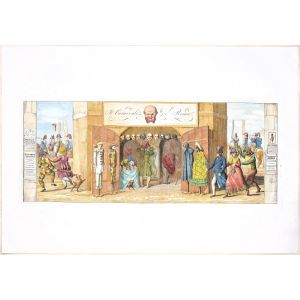
Piazza del Popolo is a beautiful etching and hand-colored gouache, finely engraved on copper and printed on laid paper. The work, which presents a remarkable quality of strokes and brilliant colors, is unsigned, but it is part of the 20 plates engraved in 1820 by the Swedish artist Carl Gustaf Hjalmar Mörner (or umo?rner) during his stay in Rome, certainly influenced by the style and manner of the coeval folkloric prints made by Bartolomeo Pinelli (cfr. Hermanin F., Una collezione di stampe e disegni dell’antico carnevale romano , Bollettino d’Arte, Rome, year I, January 1907, p. 28, cit.).
The title is engraved on plate on the lower center, and the print is numbered 6 on the lower right. The quality and conditions of preservation of the print are excellent, except only a small ink mistake on the lower right corner of the image.
The engraving is very amusing and fun, presenting an animated composition, bright colors, and a precise hatching. Furthermore, this art piece is a meaningful work also as a folkloric tale of the carefree life in Rome during the Carnival.


Piazza del Popolo is a beautiful etching and hand-colored gouache, finely engraved on copper and printed on laid paper. The work, which presents a remarkable quality of strokes and brilliant colors, is unsigned, but it is part of the 20 plates engraved in 1820 by the Swedish artist Carl Gustaf Hjalmar Mörner (or umo?rner) during his stay in Rome, certainly influenced by the style and manner of the coeval folkloric prints made by Bartolomeo Pinelli (cfr. Hermanin F., Una collezione di stampe e disegni dell’antico carnevale romano , Bollettino d’Arte, Rome, year I, January 1907, p. 28, cit.).
The title is engraved on plate on the lower center, and the print is numbered 6 on the lower right. The quality and conditions of preservation of the print are excellent, except only a small ink mistake on the lower right corner of the image.
Piazza del Popolo, one of the most famous Roman piazzas, is represented during the famous Carnival . The processions, games, and horse races started from this piazza to end up in Piazza Venezia through Via del Corso. The work describes also the side of the piazza, near the portico of one of the twin churches at the beginning of Via del Corso.
The engraving is very amusing and fun, presenting an animated composition, bright colors, and a precise hatching. Furthermore, this art piece is a meaningful work also as a folkloric tale of the carefree life in Rome during the Carnival.




Validate your login
Sign In
Create New Account