
Il Corso
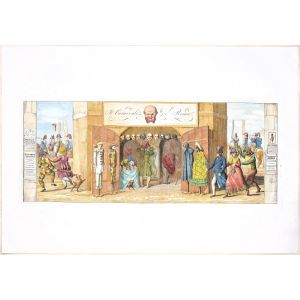
Il Corso is a beautiful etching and hand-colored gouache, finely engraved on copper and printed on laid paper. The work, which presents a remarkable quality of strokes and brilliant colors, is unsigned, but it is part of the 20 plates engraved in 1820 by the Swedish artist Carl Gustaf Hjalmar Mörner (or umo?rner) during his stay in Rome, certainly influenced by the style and manner of the coeval folkloric prints made by Bartolomeo Pinelli (cfr. Hermanin F., Una collezione di stampe e disegni dell’antico carnevale romano , Bollettino d’Arte, Rome, year I, January 1907, p. 28, cit.).
The title is engraved on plate on the lower center; the print is numbered 8 on the lower right. The quality and the conditions of preservation of this original print are very good, except for a small ink defect on the higher right edge of the image, and some small barely visible stains on the paper sheet.
The engraving is pleasant and fun, brightly colored, presenting a dynamic composition. This is an unusual and precious proof of the history and folklore of Rome in the XIX century.


Il Corso is a beautiful etching and hand-colored gouache, finely engraved on copper and printed on laid paper. The work, which presents a remarkable quality of strokes and brilliant colors, is unsigned, but it is part of the 20 plates engraved in 1820 by the Swedish artist Carl Gustaf Hjalmar Mörner (or umo?rner) during his stay in Rome, certainly influenced by the style and manner of the coeval folkloric prints made by Bartolomeo Pinelli (cfr. Hermanin F., Una collezione di stampe e disegni dell’antico carnevale romano , Bollettino d’Arte, Rome, year I, January 1907, p. 28, cit.).
The title is engraved on plate on the lower center; the print is numbered 8 on the lower right. The quality and the conditions of preservation of this original print are very good, except for a small ink defect on the higher right edge of the image, and some small barely visible stains on the paper sheet.
This original print shows the Roman Via del Corso during the Carnival period, with some disguised characters walking and running. The famous Roman Carnival was a period of play and carefreeness for Roman citizens. The events and public games took place right in the Via del Corso, where many disguised Roman citizens met up.
The engraving is pleasant and fun, brightly colored, presenting a dynamic composition. This is an unusual and precious proof of the history and folklore of Rome in the XIX century.


Validate your login
Sign In
Create New Account